Saturday, July 9, 2011

MASTERS OF THE UNIVERSE?

Lol. Far from it.

We are clearly not the masters of the universe. If we are then why are our units of distance (miles and kilometers) and time (year, decade, even lifetime) inadequate for describing the size of space?

In this beautiful image, the center of our galaxy is encircled.

Here's how I imagine this image to be.

Our destination is our galactic center. There it is, encircled in black. It's at the end of a very long transparent tunnel that extends from the earth. This is the sight we'll see as we rush through the tunnel.

philosophytoastronomy


Human distances (miles and kilometers) are inadequate for the job of space travel. Even the speed of light, which we'll use, is not impressive as a measure of speed.

Even if we traveled at the speed of light, it would take 35 minutes to pass the first object, the planet Jupiter (encircled in red). Then we would have to wait 600 years before we pass the next object, the beautiful star, Antares (encircled in white). Finally, after countless lifetimes, in 26,000 years, we would reach the center of our galaxy.

Come to think of it, human time (years, decades, and lifetimes) is also inadequate!

Antares

Antares is the alpha star of the zodiac constellation Scorpius.

If you follow astrology and your birthday falls between October 24 and November 21, you're a Scorpio.

Stars in a constellation are lettered (as opposed to being numbered) using the Greek alphabet. Most of the time, the brightest star is alpha, the second-brightest, beta, and so forth.


Source of Image

The astrophotography site of Mr. Jerry Lodriguss.
Sphere: Related Content

Saturday, May 21, 2011

SOCIAL MEDIA IN ACTION

SOCIAL MEDIA IN ACTION


What started it.


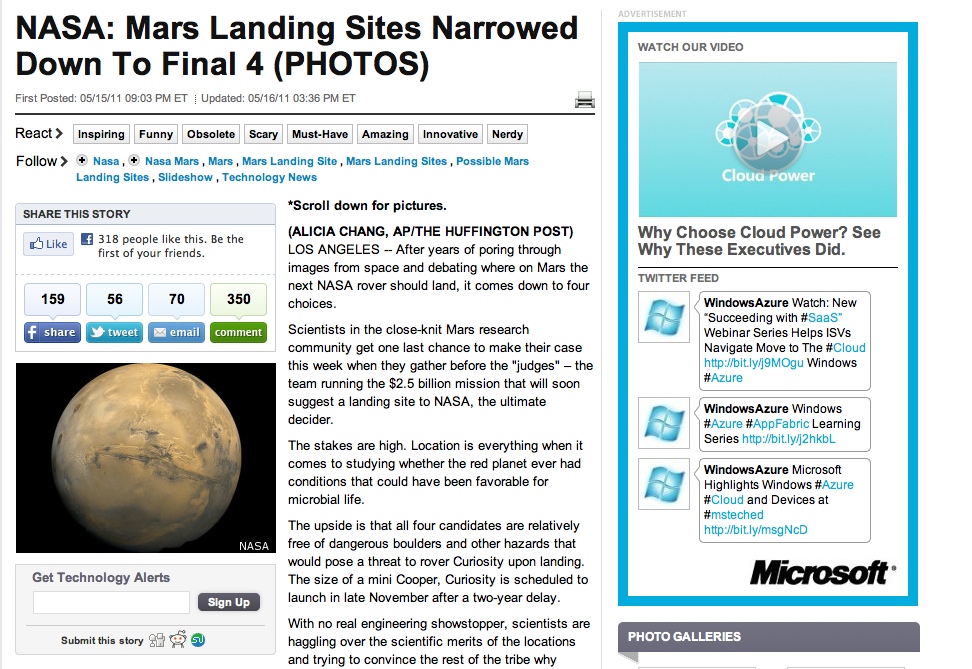
The article that started it was the one on the left. Notice the many social media buttons. And notice also the Microsoft ad. It's using tweets in the ad content. Tweeting is another social media tool, a powerful one.


I returned to the Philippines after 25 years in the States. That's what I'm blogging about.

Sphere: Related Content

Friday, May 6, 2011

IT'S DIFFICULT, IF NOT IMPOSSIBLE, TO VISUALIZE THIS.

This is an item I am re-posting from its source. A flare-up in a jet of matter blasting from a monster black hole is giving astronomers an incredible light show.

The outburst is coming from a blob of matter, called HST-1. It's embedded in the jet which is a powerful narrow beam of hot gas produced by a supermassive black hole residing in the core of the giant elliptical galaxy M87.


HST-1 is so bright that it is outshining even M87's brilliant core, whose monster black hole is one of the most massive yet discovered.


The glowing gas clump has taken astronomers on a rollercoaster ride of suspense. Astronomers watched HST-1 brighten steadily for several years, then fade, and then brighten again. They say it's hard to predict what will happen next.


Hubble Witnesses Flare-Up in Extragalactic Jet

Source: Hubblesite.org

Sphere: Related Content

Monday, October 4, 2010

DEPRESSION PLUS HEART DISEASE A PARTICULARLY LETHAL COMBINATION

This is an item I am re-posting from its source.

September 21, 2010 — Patients who have both coronary heart disease (CHD) and depression have a significantly higher risk of dying than patients who have just one of these conditions, according to new research published online September 16 in the journal, Heart.


Compared with patients without depression and CHD, the risk for all-cause mortality was 3 times higher, and the risk for cardiovascular disease mortality 4 times higher, in patients who had both, after adjusting for age and sex, report Hermann Nabi, MD, from Hôpital Paul-Brousse, Villejuif, Paris, France, and colleagues.

This study provides further evidence that the relationship between depression and morbidity–mortality is real,” Dr. Nabi told Medscape Medical News.

Depression and mortality have been studied separately in patients with CHD and in healthy patients, but this does not allow comparisons across risk-factor groups according to depression and CHD status.

In the study, Dr. Nabi and his team examined the effects of both on mortality in nearly 6,000 middle-aged men and women whose mental and physical health were followed-up for about 5.6 years.

Need for a More Integrated Approach: The study findings have implications for research and clinical practice, Dr. Nabi said.

For clinical practice, it implies the need for a more integrated approach in the healthcare system and a shift toward a more “mind–body medicine” approach.

An important step would be to identify cardiac patients who also have depression, he said.

“In this study, depression worsened heart disease, because we observed that participants with both depression and heart disease were at increased risk for death when compared with those with heart disease only. So we should identify those cardiac patients who have clinically significant depressive symptoms.”

Dr. Nabi expressed the wish that his study findings will prompt clinicians to be aware of and look for depression in their patients with heart disease.

He also discussed some limitations of the study. “This study is based on a cohort (population) of civil servants and did not include blue-collar workers, unemployed, or individuals with precarious jobs. This may have underestimated the magnitude of associations observed in our study because the prevalence of depression and the mortality rate are higher in these latter individuals. Thus, it is reasonable to assume that the effect of depression would be greater in studies including various populations.”

Reference: MedscapeCME Clinical Briefs: “Depression Plus Heart Disease a Particularly Lethal Combination”
Sphere: Related Content

Thursday, August 26, 2010

EFFECTIVE HOSTAGE-NEGOTIATION

Earlier this week, the Philippine National Police embarrassed itself and the nation by bungling the outcome of a hostage situation. (Click here, here, and here for three accounts of the incident: by a local TV station, by Reuters, and by CNN.)

A good friend of mine sent me an email describing how Chinese authorities, in a situation with many similarities, handled their hostage situation. Here it is:


FIRST, I have three demands. Meet them or I shall kill this hostage.


SECOND, The authorities confer in the next room.


THIRD, The head negotiator speaks with the hostage-taker.


FOURTH, Negotiations continue.


FIFTH, Negotiations conclude.


SIXTH, The mess is cleaned up and life move on.


As you can see, the situation was resolved quickly, inexpensively, and effectively. To illustrate one similarity between this situation and the recent Philippine incident, the photo below shows the hostage-taker in the recent Philippine incident. It was was taken during his negotiation with the Philippine authorities.


Why wasn’t he just shot at this point?

Another example of the police’s mistake occurred when they attempted to shatter the bus windows with a sledgehammer. The windows simply bounced back. They should have used a spring-loaded pointed tool or even this $15 pointed hammer:

Sphere: Related Content

Thursday, May 6, 2010

Wednesday, March 24, 2010

Whether true or not, it’s better to be safe than sorry.

After tossing her books on the sofa, she decided to grab a snack and get on-line. She logged on under her screen name and saw GoTo123 was on.

She sent him an instant message:
  1. ByAngel213: Hi. I’m glad you are on! I thought someone was following me home today. It was really weird!
  2. GoTo123: LOL. You watch too much TV. Why would someone be following you? Don’t you live in a safe neighborhood?
  3. ByAngel213: Of course I do. LOL I guess it was my imagination cuz’ I didn’t see anybody when I looked out.
  4. GoTo123: Unless you gave your name out on-line. You haven’t done that have you?
  5. ByAngel213: Of course not. I’m not stupid you know.
  6. GoTo123: Did you have a softball game after school today?
  7. ByAngel213: Yes and we won!
  8. GoTo123: That’s great! Who did you play?
  9. ByAngel213: We played the Hornets. LOL. Their uniforms are so gross! They look like bees. LOL
  10. GoTo123: What is your team called?
  11. ByAngel213: We are the Canton Cats. We have tiger paws on our uniforms. They are really cool.
  12. GoTo123: Did you pitch?
  13. ByAngel213: No I play second base. I got to go. My homework has to be done before my parents get home. I don’t want them mad at me. Bye!
  14. GoTo123: Catch you later. Bye.
Meanwhile, GoTo123 went to the member menu and began to search for her profile. When it came up, he highlighted it and printed it out. He took out a pen and began to write down what he knew about Angel so far.
  • Her name: Shannon
  • Birthday: Jan. 3, 1997
  • Age: 13
  • State where she lived: North Carolina
  • Hobbies: softball, chorus, skating and going to the mall.
Besides this information, he knew she lived in Canton because she had just told him. He knew she stayed by herself until 6:30 p.m. every afternoon until her parents came home from work. He knew she played softball on Thursday afternoons on the school team, and the team was named the Canton Cats. Her favorite number 7 was printed on her jersey. He knew she was in the eighth grade at the Canton Junior High School She had told him all this in the conversations they had on-line. He had enough information to find her now.

Shannon didn’t tell her parents about the incident on the way home from the ballpark that day. She didn’t want them to make a scene and stop her from walking home from the softball games. Parents were always overreacting and hers were the worst. It made her wish she was not an only child. Maybe if she had brothers and sisters, her parents wouldn’t be so overprotective.

By Thursday, Shannon had forgotten about the footsteps following her. Her game was in full swing when suddenly she felt someone staring at her. It was then that the memory came back. She glanced up from her second base position to see a man watching her closely. He was leaning against the fence behind first base and he smiled when she looked at him. He didn’t look scary and she quickly dismissed the sudden fear she had felt.

After the game, he sat on a bleacher while she talked to the coach. She noticed his smile once again as she walked past him. He nodded and she smiled back. He noticed her name on the back of her shirt. He knew he had found her. Quietly, he walked a safe distance behind her. It was only a few blocks to Shannon’s home, and once he saw where she lived he quickly returned to the park to get his car. Now he had to wait. He decided to get a bite to eat until the time came to go to Shannon’s house. He drove to a fast food restaurant and sat there until time to make his move.

Shannon was in her room later that evening when she heard voices in the living room.

“Shannon, come here,” her father called. He sounded upset and she couldn’t imagine why. She went into the room to see the man from the ballpark sitting on the sofa. “Sit down,” her father began, “this man has just told us a most interesting story about you.” Shannon sat back. How could he tell her parents anything? She had never seen him before today!

“Do you know who I am, Shannon?” the man asked. “No,” Shannon answered. “I am a police officer and your online friend, GoTo123.” Shannon was stunned. “That’ s impossible! GoTo is a kid my age! He’s 14. And he lives in Michigan!”

The man smiled. “I know I told you all that, but it wasn’t true. You see, Shannon, there are people on-line who pretend to be kids; I was one of them. But while others do it to injure kids and hurt them, I belong to a group of parents who do it to protect kids from predators. I came here to find you to teach you how dangerous it is to talk to people on-line. You told me enough about yourself to make it easy for me to find you. You named the school you went to, the name of your ball team and the position you played. The number and name on your jersey just made finding you a breeze.”

Shannon was stunned. “You mean you don’t live in Michigan?” He laughed. “No, I live in Raleigh It made you feel safe to think I was so far away, didn’t it?” She nodded.

“I had a friend whose daughter was like you. Only she wasn’t as lucky. The guy found her and murdered her while she was home alone. Kids are taught not to tell anyone when they are alone, yet they do it all the time on-line. The wrong people trick you into giving out information a little here and there on-line. Before you know it, you have told them enough for them to find you without even realizing you have done it. I hope you’ve learned a lesson from this and won’t do it again. Tell others about this so they will be safe too?”

“It’s a promise!” That night Shannon and her Dad and Mom all knelt down together and thanked God for protecting Shannon from what could have been a tragic situation.

Reposted from our Yahoo Group. Thanks Benj.
Sphere: Related Content

Thursday, February 11, 2010

ASSERTING YOURSELF

assertive

ASSERTING YOURSELF
Poster: http://shop.climb.org

As the poster says:
  • express your feelings
  • ask for what you want
  • say no to something you don’t want
  • be aware of your emotional intensity
  • be sensitive to the risk of violence

BEFORE YOU CAN BE ASSERTIVE

You must be aware of your self before you can be assertive. Being aware of your self is not at all similar to being aware of yourself. When you are aware of “your self,” you are aware of you as another person. You are aware of your feelings, your reasons, and the risk to your personal situation. “Yourself,” by contrast, refers simply to you. It is merely a pronoun.

You must believe that you have the right to ask for what you want. You must prepare your mind and spirit, sometimes on the spot, for the situation that will arise after you become assertive. Be prepared for anything and above all, always be in control of your own emotions. Do not lose control. Let the other person lose his. He who loses it loses.

DID YOU KNOW?

When you act assertively, you help develop your own sense of self-respect and self-worth. Also, assertive behavior generally wins more respect for you from others. In the long run, being assertive also helps make other people more comfortable with you since they will know where you stand. A few people will decide not to like you but they will be few.

WHY IS IT DIFFICULT TO BE ASSERTIVE?

It can be difficult to act assertively when you are anxious or anxiety-prone. However there is no choice. If you decide to act assertively, you must set aside your anxiety. Do whatever it takes to set aside your anxiety. That is necessary in order to act assertively successfully.

Remember that you can’t be nice or pleasing to everyone. This concern can hold back a person from becoming assertive. Realize that it is possible to become nice or pleasing to people even after being assertive with them. In truth, it depends upon the maturity of every other person. Most people will recognize that you are just being assertive. A few will misinterpret your assertiveness. There is nothing you can do about that. It is a question of maturity of every other person.

In a sense this is the largest risk you take with being assertive. People will reveal, through their individual reactions, some of their inner character.

ALTERNATIVES TO BEING ASSERTIVE

The alternatives are undesirable. You can submit (i.e., be submissive). Submission brings up its particular set of negative consequences. Or you can be aggressive, passive-aggressive, or manipulative. Each is discussed below.

DO NOT CROSS THE LINE. DO NOT BECOME AGGRESSIVE YOURSELF.

You can act too assertively also. Assertive becomes aggressive. And aggressive behavior can cause violence. Refrain from communicating in a demanding, abrasive, or hostile manner. Those are aggressive manners. Unchecked aggression can lead to violence and violence ultimately creates a lose-lose situation.

PASSIVE-AGGRESSIVE

When you react this way, you appear to go along but constantly express your anger and aggressive feelings in covert fashion. Behaving in a passive-aggressive manner tends to be corrosive. The issue that caused your anger becomes sensitive and, unchecked, could grow and dominate your relationship with that person. You’re angry at your boss, so you’re always late for work. Your boss may never understand why you’ve started coming in late. Unless you tell him your boss may attribute your frequent tardiness to another reason. Passive-aggressive behavior tends to confuse other people. Confusion tends to turn into resentment or anger. As illustrated, corrosiveness brings on negative consequences.

MANIPULATIVE

A manipulative person attempts to get what he wants by making others feel guilty or sorry for him. Instead of taking responsibility for his needs, he tries to make others feel guilty or sorry for him. He does this by casting himself as a victim or martyr. If this doesn’t work, he may become openly angry or feign indifference. Be prepared for either reaction. Manipulation only works as long as those to whom it is targeted fail to recognize what is happening.

BACK TO ASSERTIVE

Assertive behavior resembles controlled aggression, in my opinion. It is mostly a matter of intensity. You can be assertive without communicating in a demanding, abrasive, or hostile manner. Be controlled and firm. Be steadfast and clear about your message. Present your message as a direct request. Do not present it as a demand or command. “Boss, I really think I should have been reimbursed.” Say that and stop being late for work.

Source: Marital Counseling
Sphere: Related Content

Monday, January 4, 2010

Blackberry Bold 9700A DISAPPOINTING INTERFACE SPOILED THIS USER’S EXPERIENCE.

Pros: Lightweight, Strong Signal
Cons: Difficult To Use, Awkward Keypad
Best Uses: Making Calls
Describe Yourself: Business Professional, Gearhead, Practical

After becoming accustomed to the iPhone’s touchscreen, this was a disappointment. The importance of the user interface moved to the forefront for me. The trackpad is an awkward substitute. For instance, there doesn’t appear to be any way to modify the tracking range of motion. Consequently, navigating between fields requires a delicate touch and that luxury isn’t always available.

Two lesser reasons for dissatisfaction are the plain-vanilla browser and the difficulty of learning some of the ways to modify the default settings. The browser is merely adequate. Even RIM acknowledges that. As for modifying the default settings, I particularly want to learn now how to (1) reset the clipboard, (2) prevent the phone number from being assigned to the work field when the number is added to contacts, and (3) assign Opera as the default browser.

Unfortunately, my dissatisfaction with the user interface overshadows the rest of this phone’s good features. It makes phone calls very well. As a regular phone therefore it’s been doing a good job. That can be attributed to the phone’s design and the robust coverage of the carrier. As a smartphone, it’s inadequate but that can be attributed to my prior experience with the iPhone.
Sphere: Related Content

Sunday, January 3, 2010

avatarAVATAR
The movie’s well on its way to becoming a success. It will probably create a cult-like following like Star Trek, Star Wars, Lord of the Rings, and other megahits.

I saw it today in 3D. The plot was familiar but that didn’t detract from the story. The movie’s visual effects were impressive and very enjoyable. My enjoyment of the movie, however, arose from the emotional connection that it made with me. That’s what separates Avatar from other movies that were also rich in visual effects. Waterworld (1995), for instance, was a relative dud despite Kevin Costner’s star (which might have been soaring higher than anyone else’s when the movie was released).

I think that Avatar will succeed on two levels: commercially and as a pop culture icon. There should be nothing deregatory about becoming a pop culture icon. Pop is short for popular and popular culture refers to the “totality of ideas, perspectives, attitudes, memes, images and other phenomena that are deemed preferred per an informal consensus within the mainstream of a given culture.” (Wikipedia)

Incidentally, “avatar” is a fairly new term. One of my first encounters with it occurred in Second Life. However its roots, according to Wikipedia, can be traced to Hinduism where its meaning loosely refers to the descent of a deity into the physical world. In the movie, the human protagonists are projected into the alternate reality of the alien inhabitants of the fictional planet Pandora.

I recommend it. I think you’ll enjoy it.
Sphere: Related Content

Friday, December 18, 2009

diploma, graduation cap, graduate schoolTO OUR FINANCE PROFESSOR
Dear Keith: Thank you for a course well done.

Students will learn many things in a course but realistically, only several things will be remembered with the passage of time. One of an instructor’s goals therefore should be to facilitate that.

An instructor must make a decision concerning his teaching philosophy. Should he try to teach them everything or should he teach them only enough? The answer makes a significant difference.

The first approach, in my opinion, is full of complications. How can one reasonably expect to teach students everything, even when the topics are defined by a set of Terminal Course Objectives (TCOs)? Consider the students’ attitude. Many of them probably enrolled in the class because it was necessary and not because the subject interested them. This approach has a tendency to lead an instructor who believes that these TCOs are set in stone to evaluate the performance of his students against his personal standard. An instructor, by definition, is a master of his subject. Consequently, everything that he teaches, he knows very well. That poses a dilemma, whether the instructor realizes it or not. How can a student, no matter how diligent, understand much less master, the nuances and aspects of each TCO? I contend that this approach creates a hurdle so high that students will not be able to measure up. Every nuance of each TCO counts. Every time that mastery of each nuance is not demonstrated, it counts against the student.

TCOs should serve as a guide, I think. A prudent instructor, in my mind, will use the TCOs in a flexible manner. He could, for instance, at the start of the course, survey the students in order to learn their academic objective. Someone pursuing an MBA with a concentration in Project Management would have a different perspective than someone pursuing a Master’s degree in Project Management. A survey will give the instructor more insight into the needs of his students. This might sound absurd but like anything else, instructional style can be dogmatic. To dogma I contend that one size will not fit all. Address the needs of the customer and realize that the customer is your student.

Focus on the essentials. Follow the Pareto rule. Twenty percent of what you teach will account for 80% of what is important. Might it not be wiser to focus on that 20% then? The challenge in fact is determining the content of that 20%. This is where your expertise and experience as a subject matter expert will help you.

Your method was certainly different but I think you exhibited an uncommon touch in focusing on that 20%. Thanks to this course I am more cognizant of the importance and operation of the finance side of the house.

Within the healthcare sector, my field, hospitals are a key institutional player. Since the 1990s their environment has become more competitive. Looking back I now realize that there are still plenty of managers who don’t appreciate why creditworthiness, for instance, matters. Creditworthy organizations, as you taught, enjoy improved capital market opportunities. A higher credit rating means lower interest costs. A small decrease in the capital rate will, over the life of a bond, translate into significant savings. Creditworthy hospitals also enjoy less restrictive covenants that, in turn, extend their financial flexibility. Creditworthy hospitals also experience lower costs associated with their bond issues. I did a cursory study of the performance of A-rated and C-rated hospitals and noticed that the stronger organizations tend to consolidate markets by acquiring weaker competitors. Apparently, the latter can’t compete because they lack access to cost-effective capital. One author pointed out that winners in the competition for capital are hospitals and systems that can invest in their future. Capital-poor organizations are forced to sit on the sidelines, unable to expand or upgrade their facilities. (Coile 2002).

In the face of ongoing reform initiatives, the environment will only become more turbulent. Hospitals must adopt EMR or face reductions in their Medicare and Medicaid reimbursements. Rising bad debt and charity care are becoming contentious issues as several lawsuits filed by the IRS demonstrated. Commercial health insurance payments are in flux as more and more cost shifting related to consumer-directed health plans take root. A substantial number of hospitals with aging facilities are facing new financial and operational challenges. Tight labor markets continue to exert pressure on salaries and benefits. Regulatory compliance has multiplied and become more complicated. This has increased compliance costs. And competition continues to increase due to industry consolidation and the growing presence of physician-sponsored niche operations in the most profitable service areas. In the face of these sweeping challenges, my education will certainly prove useful!

Thank you again.
Sphere: Related Content

Tuesday, December 8, 2009

BALL ON A STRING

The ball will change color if you can click on it.

This is an interactive game that uses Adobe Flash. You control a ball that dangles from a string. If you can click on the ball, it will change color. Click here to try it.


Thanks to my former boss for referring me to the site.
Sphere: Related Content

Tuesday, October 6, 2009


SOUND OF MUSIC | CENTRAL STATION ANTWERP (BELGIUM)

Since a nephew pointed it out, I’ve watched this YouTube video time and again without tiring of it.

Click here and enjoy!

About this video: In this promotion, more than 200 dancers danced to “Do-Re-Mi” at the Central Station of Antwerp. It took the morning commuter crowd of 23 March 2009 by surprise. It was organized by a Belgian television program that was looking for someone to play the leading role in its version of “The Sound of Music.” This video was even noted in Wikipedia.

It is truly a feel-good video!
Sphere: Related Content

Wednesday, September 23, 2009

kurzweilIMMORTALITY IN THE NEAR FUTURE?

If not for his record, I wouldn’t give this a second thought. Immortality! Most people would like that I think.

Scientist Ray Kurzweil claims humans could become immortal in as little as 20 years’ time through nanotechnology and an increased understanding of how the body works.

The 61-year-old American, who has predicted new technologies arriving before, says our understanding of genes and computer technology is accelerating at an incredible rate. He says theoretically, at the rate our understanding is increasing, nanotechnologies capable of replacing many of our vital organs could be available in 20 years time.

Mr Kurzweil adds that although his claims may seem far-fetched, artificial pancreases and neural implants are already available.

Kurzweil’s version of immortality may not fit most people’s vision though.
Ultimately, nanobots will replace blood cells and do their work thousands of times more effectively.

Within 25 years we will be able to do an Olympic sprint for 15 minutes without taking a breath, or go scuba-diving for four hours without oxygen. Heart-attack victims—who haven’t taken advantage of widely available bionic hearts—will calmly drive to the doctors for a minor operation as their blood bots keep them alive.

Nanotechnology will extend our mental capacities to such an extent we will be able to write books within minutes. If we want to go into virtual-reality mode, nanobots will shut down brain signals and take us wherever we want to go. Virtual sex will become commonplace. (It better be as good as the real thing!) And in our daily lives, hologram-like figures will pop in our brain to explain what is happening.

So we can look forward to a world where humans become cyborgs, with artificial limbs and organs.
I’ve followed Mr. Kurzweil for the past two decades. According to Wikipedia, among his accomplishments are:
  • a statistical processing program that he wrote at age 15 that was later used by IBM.
  • a pattern-analysis program that analyzed classical music and synthesized its own. Because of it, he appeared on national television, was recognized by the prestigious Westinghouse Talent Search (now known as the Intel Talent Search), and was personally congratulated by then-President Lyndon Johnson.
  • the first successful OCR software. In turn, this required the invention of two other technologies...
There’s more and you can read about it at Wikipedia.

In my opinion, he’s a first-rate genius. He has that rare ability to visualize possibilities and actually make them happen. If it requires tools and techniques that don’t exist, he creates them.

His genius is similar to that of Sir Isaac Newton whom I think deserves as much, if not more, praise than Albert Einstein. (By nature, we tend to be more cognizant or aware of events that happen more recently.)

Mr. Einstein, who is undoubtedly a first-rate genius, made his mark in the first half of the previous century. At least one of his discoveries assumed practical importance during the Second World War. This was his famous equation that identified the relationship between matter and energy.
e=mc2


This equation served as an important theoretical foundation for the development of the atomic bomb.

Sir Isaac Newton, on the other hand, lived in the 17th and 18th centuries. He was, according to Wikipedia, a physicist, mathematician, astronomer, philosopher, alchemist, and theologian. Two of his accomplishments impress me personally: his invention of a new type of telescope and his creation of a new form of math, calculus.

Consider that these accomplishments were just by-products of his pursuit of other goals.

The new telescope design came about due to his research into color. He was trying to prove that the color of light does not change whether it is transmitted or received (i.e., whether it originates from a flashlight or is the green that we see in leaves). His theory, for example, explains why the sky is blue. (It is not blue because it is blue. Rather it is blue because air molecules scatter blue light more than any other color. In space, where there is no air, the sky is black. Black is the color by default, i.e., the absence of color leaves only black. For more on color, click here.)

He created calculus, the new math, to help him understand the movement of bodies. The reflecting telescope (also known as the Newtonian telescope) is the most popular telescope design. The famous Hubble telescope is a reflecting telescope. The world’s largest and most modern telescopes are all Newtonians. Calculus, on the other hand, is the bane of many students. I hated it myself. On the other hand, all physical sciences use calculus to some degree. What is calculus? A good and simple definition is provided by answer.com:
Calculus is the study of the “rates of change.” There are two main branches of calculus: Differential Calculus and Integral Calculus. Differential calculus determines the rate of change of a quantity, integral calculus finds the quantity when the rate of change is known.
For more on calculus, click here.

At any rate, this is quite a prediction even coming from Mr. Kurzweil. For the moment, I just hope to be around in 2030 to learn if this or something resembling it comes true.

Links to several Kurzweil sites:
Kurzweil Technologies
Biography

The source article is here.
Sphere: Related Content

Sunday, August 30, 2009

Coffeecup SoftwareCOFFEECUP SOFTWARE COMMENDATION

According to The Free Dictionary, a Web-based reference, a commendation is a message expressing a favorable opinion.

Creating webpages is detailed work. It can be frustrating. I looked around for an editor to help me write correct HTML code. (Microsoft WORD is a general-purpose editor. I was looking for a counterpart: an HTML editor.) I experimented with a few but I only rose up the learning curve after switching to Coffeecup Software’s HTML Editor. I’ve been using it since 2003.

Coffeecup’s homepage hints at the casual easygoing nature of the group. Their motto is “fresh software, warm people.” Their nature may be casual but their products are top-notch. And their prices are reasonable. The icing is this: buy a particular application and all future upgrades of that application are free.

Back in 2003, I downloaded a trial version of HTML Editor. It was a trial version so it didn’t cost me anything. Well one of their marketing points is that they would provide free support for their software even if they were trial versions. I took them up on it. I emailed them a request for assistance. And they responded. I was impressed. That’s how I became a customer.

At any rate, I was recently notified of a new version of HTML Editor. I clicked on the emailed link and was surprised that my account was not recognized. My account is my original order number. That tells Coffeecup the specific applications that I had purchased. That’s how Coffeecup knows the free upgrades that I’m entitled to.

I emailed them about it yesterday. Today, Sunday, I received a response from Suzanne Miller, their Sales & Office Manager. Apparently my original order was linked to another email address. Suzanne updated my account and took care of the problem.

It’s not often enough that I take the time to express my appreciation for good service so I’m going to change that. I want to thank Suzanne for her prompt response. And I want to thank Coffeecup Software for having employees like Suzanne. Way to go!

This links to their free software.

This links to the trial versions of their software.

This links to their About Us.


Sphere: Related Content

Wednesday, August 19, 2009

conflict, resolution


THE IMPORTANCE OF CONFLICT RESOLUTION
I believe that one of the most important factors in a successful relationship (whether it’s between a couple, a group, societies, or countries) is the ability to resolve their differences constructively. Having compatible values is important but knowing how to resolve conflicts constructively is even more so. Regardless of how compatible the parties are, if either of them don’t know how to resolve the inevitable conflicts, their relationship is going to be difficult, if not doomed.

Conflicts are inevitable in any relationship regardless of the mutual interests or compatibility that brought them together.

There are five ways to deal with conflict:

1. Force the issue. One party forces the issue.
2. Acquiesce to the other person. Just give in.
3. Ignore the issue. Pretend there is none.
4. Compromise. Give something up in exchange for another.
5. Resolve it. Confront the differences.

The first three are obviously short-term palliatives. The fourth is the most common approach (probably because it seems most natural). But it frequently falls short of a win-win situation. I leave you to ponder that on your own.

It is the last approach that works. Seek to understand each other’s real needs and wants and develop your solution from there. I found Stephen Covey’s “The 7 Habits of Highly Effective People” very useful in this regard. That, by the way, is one of the most influential and useful books that I have ever read. I highly recommend it.
Sphere: Related Content

Monday, August 17, 2009

HOW DO JUDGES DECIDE?

Available at Amazon

Click on any image to enlarge it. Use the back arrow on your browser to return to this page.


Sphere: Related Content

Thursday, July 30, 2009

kidney, bartter syndrome, pronove, NIHTHE PRONOVE-BARTTER SYNDROME

In 1960, a team of medical scientists working at the National Institutes of Health (NIH) identified a syndrome that affects the kidneys. A syndrome is “a group of symptoms that collectively indicate a disease, disorder, or other abnormal medical condition.”

The kidney is one of the body’s vital organs. A vital organ is one that performs an essential life function. Total failure of a vital organ will cause death. We have six vital organs. These are the brain, heart, lungs, liver, pancreas and kidneys.

We have two kidneys. Their function is “to keep the blood clean and chemically balanced. Wastes in the blood come from the normal breakdown of active tissues, such as muscles, and from food. The body uses food for energy and self-repairs. After the body has taken what it needs from food, wastes are sent to the blood. If the kidneys do not remove them, these wastes build up in the blood and damage the body.”

Persons suffering from this syndrome have kidneys that fail to keep the blood chemically balanced. They lose excessive amounts of potassium. It’s a relatively rare but serious condition.

I wrote this entry simply to thank a medical historian for clarifying the origin of the syndrome’s name.


Dear Mr. Enersen,

I am a nephew of the late Dr. Pacita Pronove-Irreverre. She was the lead author of the paper that first described the condition commonly known as the Bartter Syndrome. As you know, naming rights typically belong to the lead author.

In June 2008, I successfully persuaded Wikipedia to include my aunt’s name in the Wiki entry for the Bartter Syndrome. As you also probably know, Wikipedia is edited by the user community. It is a system that ensures rigorous verification. My primary evidence consisted of the relevant entry found at your website.

Apart from expressing gratitude, I want to corroborate your detailed explanation with a firsthand account of my late-aunt’s narration about the incident. This is more trivia than anything but as a historian you might enjoy it for the life it brings to your tale.

Several years before my aunt died and definitely before I knew about the syndrome’s existence, she told me the corroborating story. Auntie Pat had narrated it to her other nephews and nieces as well. (She and her doctor husband had no children themselves.) Auntie Pat told me that after she realized that injustice had been done, she looked Fred Bartter in the eye and Fred was unable to maintain eye contact. There was a smile on her face when she narrated that.

You can picture the times. She was a diminutive Asian woman in a field populated and dominated by white American men. She was still new to the U.S. The medical paper was published in 1960, only several years after she arrived. We can speculate why she partnered with Bartter. He has a Wiki entry and it reveals that he was the son of American missionaries who were stationed in the Philippines. So our aunt, a Filipina, had a common link with him. She must have felt that she had found a friend at her place of employment, the NIH.

She maintained her association with him even after the incident. They published a second paper together. She even had her sister accompany Fred and his wife back to Baguio to locate the graveyard of his parents. When she did this, I am unsure of—I will check with my cousins if they know whether this occurred before or after the incident. She was a gentle and generous soul so either time frame was possible.

Mr. Enersen, we are grateful to you for coming up with the idea for your website. It helped us add a satisfying footnote to both medical and our family’s history. I am sure that future generations of other people will appreciate and thank you for creating such a resource.

On behalf of our extended family, I thank you.

Sincerely,

Alex Pronove

P.S. Our family is preparing Dr. Pacita’s biographical sketch for Wikipedia as well.

Sphere: Related Content

Friday, June 26, 2009

attitudeTHE POWER OF ATTITUDE

I’ve long admired those framed motivational posters I see in many offices. Here’s the one about attitude.

Our lives are not determined by what happens to us, but by how we react to what happens.

Our lives are determined not by what life brings to us, but by the attitude we bring to life.

A positive attitude causes a chain reaction of positive thoughts, events and outcomes. It is a catalyst...a spark that creates extraordinary results.


Sphere: Related Content